Latest posts

Insurance companies are now in the passenger’s seat

An insurance company is now testing a program where discounts are offered to drivers who can basically prove that they’re good drivers (at least in the opinion of the insurance company). How is this done? By monitoring your driving habits:

An electronic monitor the size of a matchbook closely tracked Sevlie’s driving time and behavior. If he had a heavy foot or was a sudden braker, the auto data recorder would betray him.

Disconnected from the car and hooked to a PC, the device relayed Sevlie’s digital driving diary to his auto insurer, Progressive Corp., with the click of a mouse during a pilot program earlier this year.

There are of course, privacy concerns, though Progressive Insurance seems to dance around this by swearing that the program is and will continue to be strictly voluntary. I just wonder if “voluntary” will eventually mean “you don’t qualify for any good driver discounts at all unless you let our matchbox sit in the passenger’s seat.”

There are also other questions I have. Progressive swears that this technolgoy does not trakc your location by any means. If that’s true, then how is any inference going to be made about whether I’m a leadfoot or not? In some states, the speed limit is 70 MPH and it may actually be a hazard to drive significantly slower than that. So what will allow them to determine the difference between a driver doing 65 on a 70MPH highway and a leadfoot doing 45 in a 15 MPH school zone? And what will differentiate between a person who brakes hard as a matter of habit (causing all kinds of havoc for everyone behind him or her in stop and go traffic) and a person who is only braking hard because s/he’s effectively evading a swoop-and-squat?

Religious nuttiness

vmary

What does the above image look like to you? To me, it looks like a random blob on a poorly made cheap balloon. But to a bunch of Texans, this blob apparently looks like the Virgin Mary:

Javier Fuentes, a salesman a Payne Weslaco Motors, says he was out to sell new cars Tuesday morning until his day “blew up” into something else.

“Everybody was blowing some balloons and we noticed that this image came from the balloon,” said Fuentes. “And everybody was agreeing that it looked like the Virgin Mary.”

On closer inspection, Fuentes says he noted that the image was more than just a possible defect on a balloon.

“That’s what I thought in the beginning and I tried to erase it and I couldn’t. I even tried to put some saliva on it and it didn’t go away.”

And some of his co-workers at the dealership say they were moved to tears after seeing the image.

Obviously I’m a skeptic. But, I’ve seen far more convincing apparitions. This? It’s a blob. Quit yer cryin’, pop the balloon, and move on, folks.

The Dubyah Bill: Accept it and say “duhhhh.”

fake

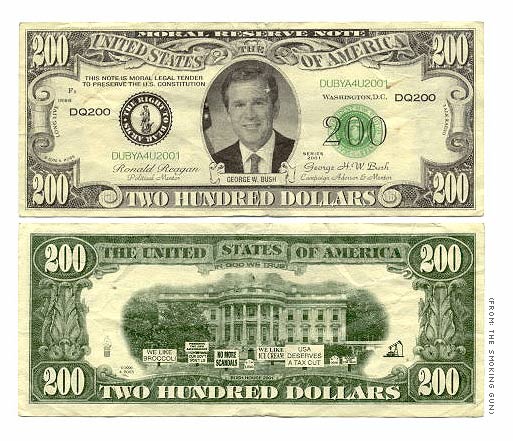
A woman in Pennsylvania managed to pass of a fake $200 bill with George W. Bush’s likeness on it:

Although there is no $200 bill in circulation, never mind one with George Bush’s picture on it, the cashier at the Fashion Bug in Hempfield Township, Pa., accepted the bill for some clothes and handed the woman about $100 in change, the paper reported.

“The cashier apparently believed it was a true piece of currency,” State Trooper Jeanne Martin told the Tribune-Review. She added that the bill most likely began circulating as a gag gift.

This seems to happen from time to time, the news reports it, and people get a laugh. And yet, no one ever learns!
This gag has been in existence since the Clinton era. But sadly, it looks like some people are too dumb to so much as accept money from people.